Amplitudes and Algebraic Geometry
The ESI program Amplitudes and Algebraic Geometry aims to develop new mathematical paradigms for the fundamental interactions of nature by bringing together physicists working on scattering amplitudes and mathematicians with expertise in real, complex, tropical and computational algebraic geometry. The program features several mini-courses, two one-week topical workshops, as well as two weeks with a light program to enable collaborations among the participants.
Schedule (see below for details of topics):
Week 1, Feb 16-20: Mini-Courses I
Week 2, Feb 23-27: Light program (approx. one talk per day)
Week 3, Mar 2-6: Mini-Courses II
Week 4, Mar 9-13: Workshop I
Week 5, Mar 16-20: Light program (approx. one talk per day)
Week 6, Mar 23-27: Workshop II
Mini-Courses I. Expected lecturers include:
Melissa Sherman-Bennet: Amplituhedra
Bernd Sturmfels: Kinematic Varieties
Lorenzo Tancredi: Feynman Integrals
Mini-Courses II. Expected lecturers include:
Francis Brown: Introduction to Motivic and Mellin periods
Daniele Dorigoni: Modular Forms and AdS/CFT
James Drummond: Cluster Algebras
Samuel Grushevsky: Theta Functions and Moduli Spaces
Workshop I: Algebra and combinatorics of amplitudes, is co-organized by Thomas Lam, Erik Panzer, and Anastasia Volovich. Topics covered include: cluster algebras, amplituhedra and surfacehedra, tropical geometry, as well as positive and binary geometry.
Workshop II: Mathematical structures of amplitudes, is co-organized by Axel Kleinschmidt, Martin Raum, and Leila Schneps. It focusses on the mathematical properties of Feynman and string amplitudes. Topics covered include: Feynman/string integrals, their differential equations, (co-)homology theories and intersection numbers; computational aspects of periods, Hodge theory, theta functions, Siegel modular forms, and moduli spaces of curves and abelian varieties.


Funded by the European Union (ERC, MaScAmp, 101167287 and UNIVERSE PLUS, 101118787). Views and opinions expressed are however those of the author(s) only and do not necessarily reflect those of the European Union or the European Research Council Executive Agency. Neither the European Union nor the granting authority can be held responsible for them.
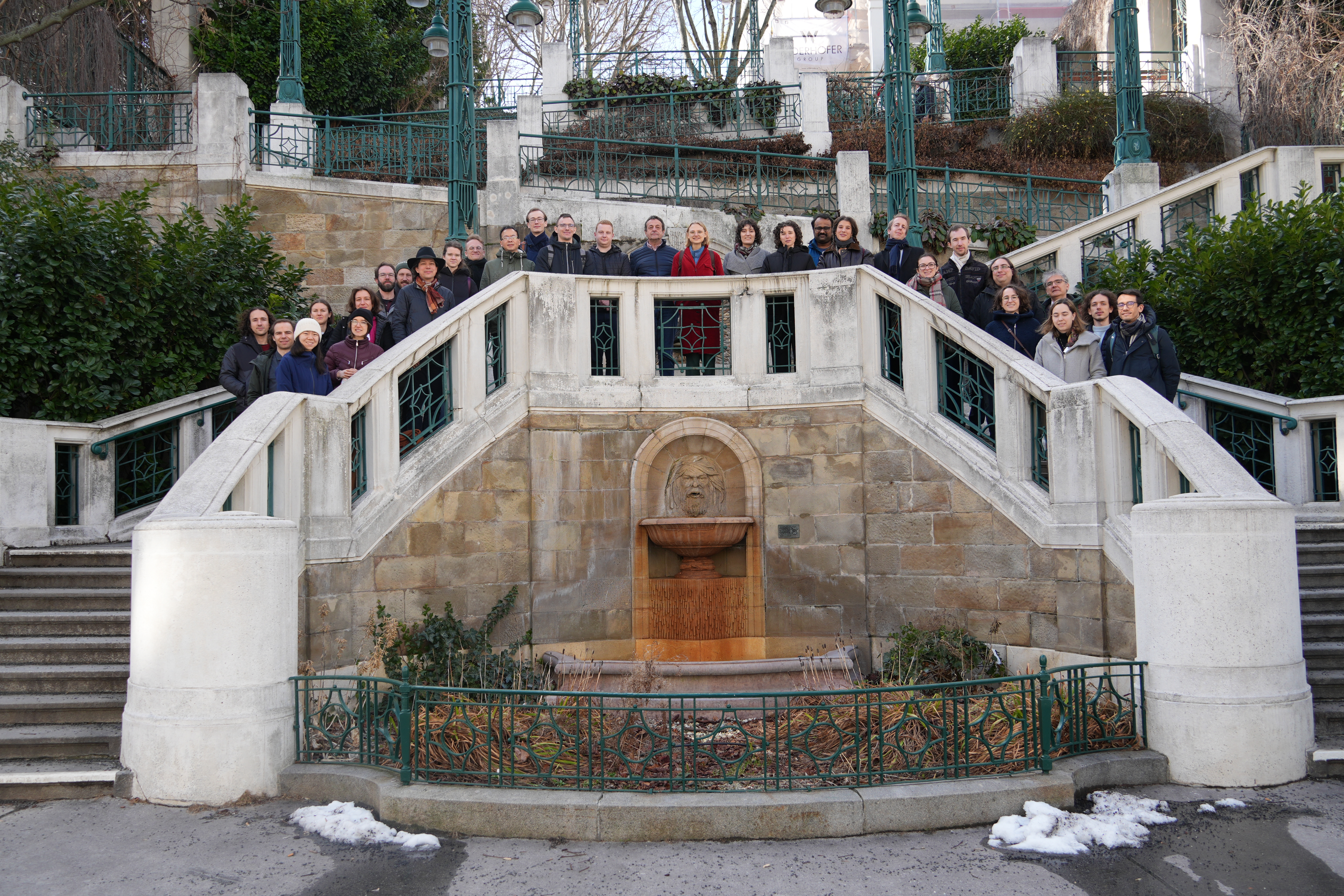
Group picture of week 1
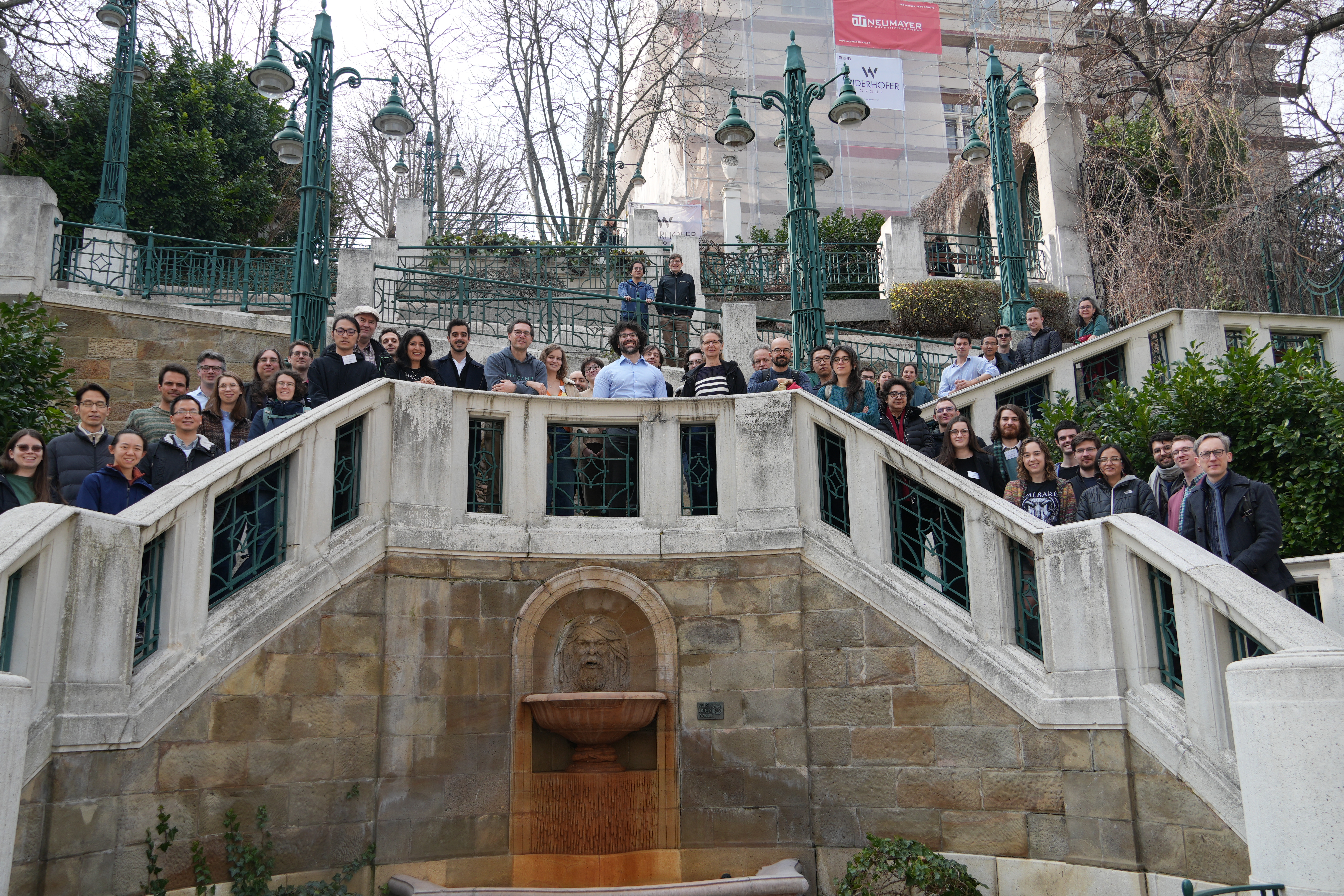
Group picture of week 3
Kinematic Varieties I:
Feynman Integrals I: Feynman integrals and integration by parts identities
Amplituhedra I
Kinematic Varieties II:
Feynman Integrals II: Parametric representations (Schwinger, Feynman and Baikov)
Amplituhedra II
Kinematic Varieties III:
Feynman Integrals III: Differential equations and canonical bases
Amplituhedra III
Kinematic Varieties IV:
Feynman Integrals IV: Integrand analysis for polylogs and beyond
Amplituhedra IV
Math-physics communication
Kinematic Varieties and Feynman Integrals
Amplituhedra
Classifying bounded ratios on cluster algebras with U-variables
Single-valued periods in superstring amplitudes at one loop
Canonical differential equations and intersection matrices
Symmetry Relations between Feynman Integrals - Three Perspectives
Connection Matrices in Macaulay2
How to stab a polytope
Thomas Lam (University of Michigan): A combinatorial model for higher tropical Grassmannians
Enumerative geometry and integrability
Correlation functions in integrable supersymmetric four-dimensional gauge theories
Modular Forms and AdS/CFT, I
Theta Functions and Moduli Spaces, I
Cluster Algebras, I
Modular Forms and AdS/CFT, II
Theta Functions and Moduli Spaces, II
Cluster Algebras, II
Modular Forms and AdS/CFT, III
Introduction to Motivic and Mellin periods, I
Introduction to Motivic and Mellin periods, II
Theta Functions and Moduli Spaces, III
Cluster Algebras, III
Toric Amplitudes and Universal Adjoints
Positive charts of toric varieties
Reciprocal A-determinants
Positive geometries and canonical forms via mixed Hodge theory
Positive del Pezzo geometry
Improving Tools for Perturbation Theory
The (loop) amplituhedron, squared amplituhedron and correlahedron.
Landau Analysis on the Grassmannian
Tilings of the Amplituhedron beyond m=4
Negative Geometry Expansion of Scattering Amplitudes
Tropical(ized) quantum field theory
Normal Fans of Voronoi Cells and Theta Functions
Graphical Scattering Equations
Type-independent canonical mirror models for cominuscule homogeneous spaces
The ABCT Variety V(3,n) is a Positive Geometry
Is the amplituhedron a positive geometry?
Cluster algebraic structures in Feynman integrals
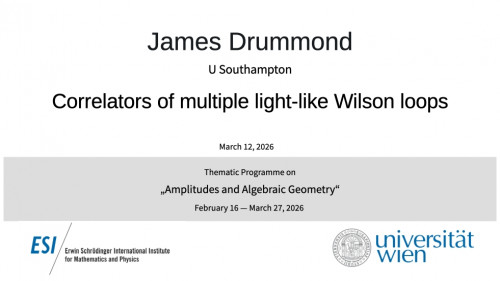
Correlators of multiple light-like Wilson loops
The cosmological combinatorics of wavefunctions and correlators
Amplitude tools for cosmological correlators: part I
Amplitude tools for cosmological correlators: part II
Pellytopes and binary geometries
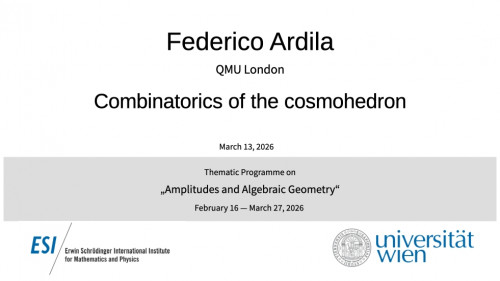
Combinatorics of the cosmohedron
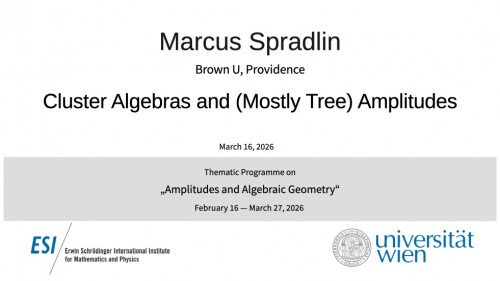
Cluster Algebras and (Mostly Tree) Amplitudes
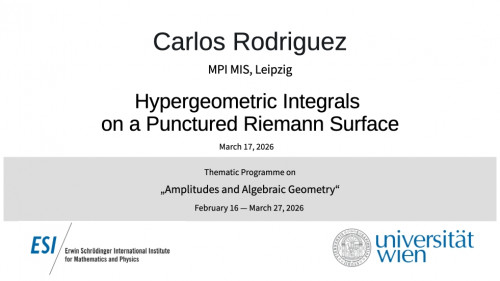
Hypergeometric Integrals on a Punctured Riemann Surface
Tropical Integration for Gauge Theory Feynman Integrals
Exact Volumes of Semi-Algebraic Convex Bodies
New algorithm for Feynman integral reduction and ε-factorised differential equations
Positive Geometries of Positive Genus
Novel cluster-algebraic letters for six- and five-point QCD processes
A First Look at Bootstrapping QCD Amplitudes
Black hole scattering, Feynman graph expansions and Calabi-Yau geometries
The geometry of Feynman integrals
Generalized third kind forms and their period integrals in Feynman integrals
Singularities and annihilators of Feynman integrals
Positive Geometries as Dual Volumes
Rank-jumping, resonance, and restrictions of Feynman integrals
Single-valued polylogarithms for all genera
Relating spaces of polylogarithms on Riemann surfaces
Two families of K3 surfaces attached to root lattices
Canonical mirror models for cominuscule homogeneous spaces
Resurgence and arithmetic of non-perturbative effects
Resurgent Lambert series in quantum field theory and string theory (plus hyper-asymptotics from the cosmohedron)
Numerical computations of periods
Reflexive Polytopes and the Convergence of Feynman Integrals
New developments in the theory of graphical functions
Mellinology for Energy Correlators
Hopf algebra structures for multiple (q-)zeta values
Multiple zeta values, Grothendieck-Teichmüller theory and higher genus
Automorphic Differential Operators
A diagramatic coaction for FRW power-law cosmological correlators
From Partition Functions and Anomalies to L-functions and Secondary Periods
Organizers
| Name | Affiliation |
|---|---|
| Daniele Agostini | University of Tübingen |
| Lara Bossinger | Universidad Nacional Autónoma de México |
| Ruth Britto | Trinity College, Dublin |
| Johannes Henn | Max Planck Institute for Physics |
| Jianrong Li | University of Vienna |
| Anna-Laura Sattelberger | Max Planck Institute for Mathematics in the Sciences, Leipzig |
| Oliver Schlotterer | Uppsala University |
Attendees
| Name | Affiliation |
|---|---|
| Simonetta Abenda | University of Bologna |
| Niklas Affolter | Vienna University of Technology |
| Ankit Aggarwal | TU Wien |
| Rigers Aliaj | DESY Hamburg |
| Athanasia-Konstantina Angelopoulou | Trinity College, Dublin |
| Federico Ardila | Queen Mary University of London |
| Konstantin Baune | ETH Zürich |
| Gideon Baur | Universität Bonn |
| Manuel Berger | ETH Zurich |
| Mattia Biancotto | Max Planck Institute for Gravitational Physics, Potsdam |
| Jonathan Boretsky | McGill University |
| Michael Borinsky | Perimeter Institute, Waterloo |
| Viktoriia Borovik | Max Planck Institute for Mathematics in the Sciences, Leipzig |
| Guillaume Bossard | CNRS & Ecole Polytechnique, Palaiseau |
| Jacob Bourjaily | The Pennsylvania State University |
| David Broadhurst | The Open University |
| Johannes Broedel | ETH Zürich |
| Francis Brown | University of Oxford |
| Nero Budur | KU Leuven |
| Annika Burmester | Bielefeld University |
| Veronica Calvo Cortes | Max Planck Institute for Mathematics in the Sciences, Leipzig |
| Livia Campo | University of Vienna |
| Sérgio Carrôlo | Max Planck Institute for Physics |
| Ana-Maria Castravet | University of Versailles Saint-Quentin |
| Türkü Özlüm Çelik | Max Planck Institute, Dresden |
| Vsevolod Chestnov | University of Oxford |
| Emiel Claasen | Max Planck Institute for Gravitational Physics, Potsdam |
| Lucas Dauger | Université de Jussieu |
| Claire de Korte | Max Planck Institute for Mathematics in the Sciences, Leipzig |
| Eric D'Hoker | University of California, Los Angeles |
| Sandra Di Rocco | KTH Stockholm |
| Daniele Dorigoni | Durham University |
| James Drummond | University of Southampton |
| Clément Dupont | Université de Montpellier |
| Nick Early | Institute for Advanced Study, Princeton |
| Benjamin Enriquez | Institut de Recherche Mathématique Avancée |
| Chaim Even-Zohar | Technion Haifa |
| Livia Ferro | University of Hertfordshire |
| Claudia Fevola | INRIA Saclay |
| Hadleigh Frost | Institute for Advanced Study, Princeton |
| Jens Funke | Durham University |
| Herbert Gangl | Durham University |
| Alheydis Geiger | Max Planck Institute for Mathematics in the Sciences, Leipzig |
| Alessandro Georgoudis | Queen Mary University of London |
| Bruno Gimenez-Umbert | University of Southampton |
| Zachary Greenberg | Max Planck Institute for Mathematics in the Sciences, Leipzig |
| Samuel Grushevsky | Stony Brook University |
| Ömer Gürdoğan | University of Southampton |
| Marvin Anas Hahn | Trinity College, Dublin |
| Luke Hamilton | University of Oxford |
| Paul Heslop | Durham University |
| Henrik Johansson | Uppsala University |
| Deepak Kamlesh | Max Planck Institute for Mathematics, Bonn |
| Dani Kaufman | Max Planck Institute for Mathematics in the Sciences, Leipzig |
| Adam Keilthy | Trinity College, Dublin |
| Jung-Wook Kim | CERN, Geneva |
| Axel Kleinschmidt | Max Planck Institute for Gravitational Physics, Potsdam |
| Albrecht Klemm | University of Sheffield |
| Joris Koefler | Max Planck Institute for Mathematics in the Sciences, Leipzig |
| Christian Krattenthaler | University of Vienna |
| Thomas Lam | University of Michigan |
| Craig Larkin | University of Edinburgh |
| Sangmin Lee | Korea Institute for Advanced Study |
| Franca Lippert | Universität Bonn |
| Tomasz Lukowski | University of Hertfordshire |
| Rourou Ma | University of Science and Technology of China |
| Sara Maggio | Universität Bonn |
| Abhiram Mamandur Kidambi | Max Planck Institute for Mathematics in the Sciences, Leipzig |
| Yelena Mandelshtam | University of Michigan |
| Marcella Manivel | University of Minnesota |
| Lionel Mason | University of Oxford |
| Antonela Matijasic | Johannes-Gutenberg Universität Mainz |
| Saiei-Jaeyeong Matsubara-Heo | Tohoku University |
| Elia Mazzucchelli | Max Planck Institute for Physics |
| Andrew McLeod | University of Edinburgh |
| Ulysse Mounoud | Université de Montpellier |
| Sergey Mozgovoy | Trinity College, Dublin |
| Christoph Nega | Albert-Einstein-Institute |
| Erik Panzer | University of Oxford |
| Georgios Papathanasiou | National and Kapodistrian University of Athens |
| Matteo Parisi | Okinawa Institute of Science and Technology |
| Dmitrii Pavlov | Max Planck Institute for Physics |
| Enrico Perron Cabus | Uppsala University |
| Anaelle Pfister | Max Planck Institute for Mathematics in the Sciences, Leipzig |
| Eric Pichon-Pharabod | Max Planck Institute for Mathematics in the Sciences, Leipzig |
| Sebastian Pögel | University of Zurich |
| Andrzej Pokraka | University of Amsterdam |
| Maria Polackova | University of Edinburgh |
| Jean-Luc Portner | University of Oxford |
| Lizzie Pratt | University of California, Berkeley |
| Prashanth Raman | Max Planck Institute for Physics |
| Martin Raum | Chalmers University of Technology |
| Claudia Rella | Institut des Hautes Etudes Scientifiques |
| Lecheng Ren | Queen Mary University of London |
| Niall Robertson | Trinity College, Dublin |
| Carlos Rodriguez | Max Planck Institute for Mathematics in the Sciences, Leipzig |
| Michele Santagata | National Taiwan University |
| Michael Schlosser | University of Vienna |
| Leila Schneps | CNRS Paris |
| Oliver Schnetz | University of Hamburg |
| Florian Seefeld | University of Southern Denmark |
| Cathrin Semper | Universität Bonn |
| Didina Serban | IPhT Saclay |
| Emre Sertöz | Leiden University |
| Dawei Shen | University of Michigan |
| Melissa Sherman-Bennett | University of California, Davis |
| Aleksander Shmakov | University of Stockholm |
| Rainer Sinn | University of Leipzig |
| Yoann Sohnle | Uppsala University |
| Peter Spacek | Max Planck Institute for Mathematics in the Sciences, Leipzig |
| Marcus Spradlin | Brown University |
| Sven Stawinski | Universität Bonn |
| Thomas Stone | Technische Universität München |
| Bernd Sturmfels | Max Planck Institute for Mathematics in the Sciences, Leipzig |
| Balazs Szendroi | University of Vienna |
| Lorenzo Tancredi | Technical University of Munich |
| Simon Telen | Max Planck Institute for Mathematics in the Sciences, Leipzig |
| Felix Tellander | Trinity College, Dublin |
| Ayush Kumar Tewari | Radon Institute, RICAM |
| Hannah Tillmann-Morris | King's College London |
| Jaroslav Trnka | University of California, Davis |
| Pierre Vanhove | IPhT Saclay |
| Cristian Vergu | The Pennsylvania State University |
| Anastasia Volovich | Brown University |
| Stefan Weinzierl | Johannes-Gutenberg Universität Mainz |
| Nicolas Alexander Weiss | Max Planck Institute for Mathematics in the Sciences, Leipzig |
| Brandon Williams | Heidelberg University |
| Qinglin Yang | Max Planck Institute for Physics |
| Claudia He Yun | The Arctic University of Norway |
| Francesca Zaffalon | Max Planck Institute for Mathematics in the Sciences, Leipzig |
| Federico Zerbini | UNED |
| Shun-Qing Zhang | Max Planck Institute for Physics |
| Yang Zhang | University of Science and Technology of China |
| Yao-Qi Zhang | University of Hertfordshire |
Feb. 16, 2026 11:15 — 12:30
Feb. 17, 2026 11:15 — 12:30
Feb. 18, 2026 11:15 — 12:30
Feb. 19, 2026 11:15 — 12:30
Feb. 23, 2026 10:30 — 11:30
Feb. 26, 2026 10:30 — 11:30
Feb. 27, 2026 10:30 — 11:30
March 2, 2026 11:15 — 12:30
March 3, 2026 11:15 — 12:30
March 4, 2026 11:15 — 12:30
March 5, 2026 09:30 — 10:45
March 5, 2026 11:15 — 12:30
March 9, 2026 10:45 — 11:45
March 9, 2026 14:15 — 15:15
March 10, 2026 09:30 — 10:30
March 10, 2026 10:45 — 11:45
March 10, 2026 14:15 — 15:15
March 10, 2026 15:45 — 16:45
March 11, 2026 09:15 — 10:15
March 12, 2026 09:30 — 10:30
March 12, 2026 10:45 — 11:45
March 16, 2026 10:30 — 11:30
March 17, 2026 10:30 — 11:30
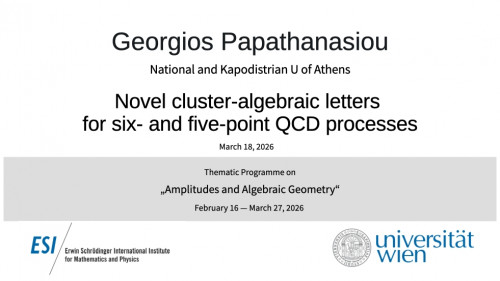
March 18, 2026 10:30 — 11:30
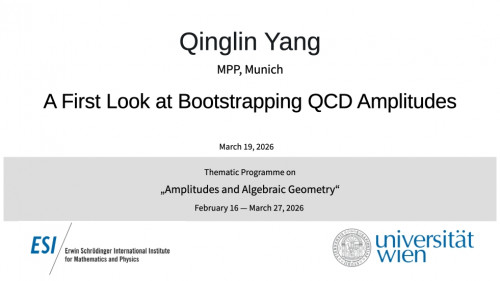
March 19, 2026 10:30 — 11:30
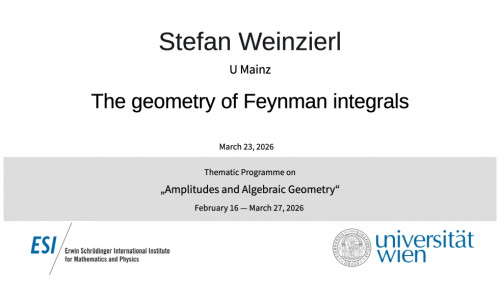
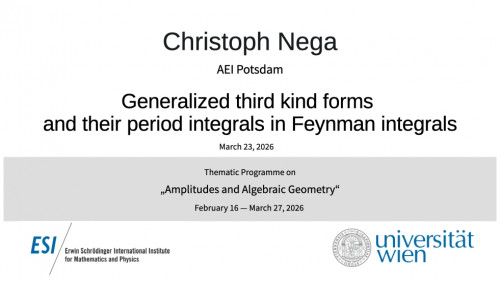
March 23, 2026 10:45 — 11:45
March 23, 2026 15:45 — 16:45
March 24, 2026 09:30 — 10:30
March 24, 2026 14:15 — 15:15
March 25, 2026 10:45 — 11:45
March 25, 2026 11:45 — 12:45
March 26, 2026 09:15 — 10:15
March 26, 2026 10:45 — 11:45
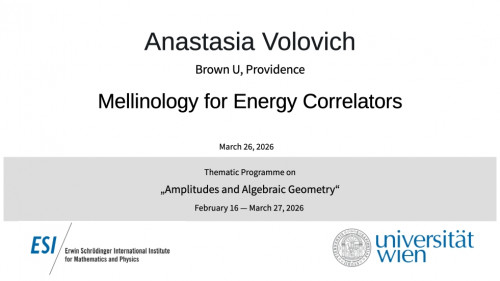
March 26, 2026 11:45 — 12:45
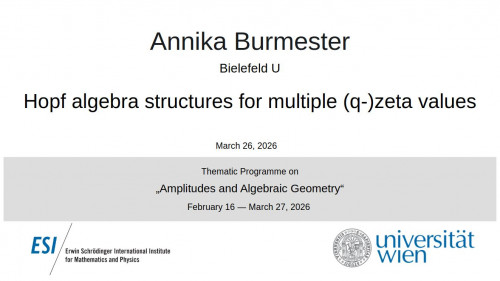
March 26, 2026 14:15 — 15:15
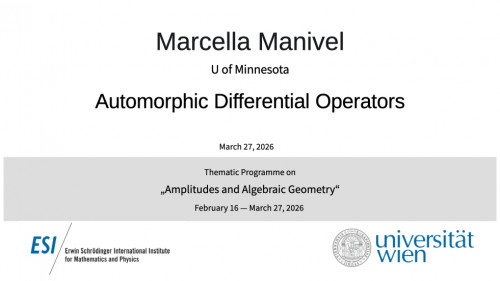
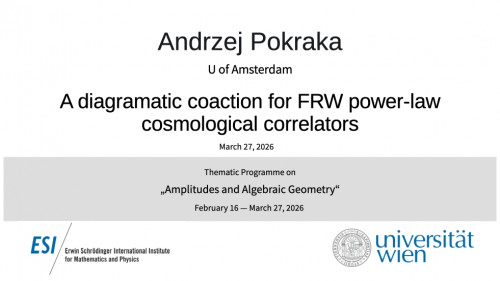
March 27, 2026 10:45 — 11:45
- Type:
- Thematic Programme
- When:
- Feb. 16, 2026 — March 27, 2026
- Where:
- ESI Boltzmann Lecture Hall
- Organizer(s):
-
Daniele Agostini (U Tübingen)
Lara Bossinger (UNAM, Oaxaca)
Ruth Britto (Trinity College, Dublin)
Johannes Henn (MPP, Munich)
Jianrong Li (U of Vienna)
Anna-Laura Sattelberger (MPI MIS, Leipzig)
Oliver Schlotterer (Uppsala U)