New Paradigms for Harnessing Quantum Field Theory at Colliders
Warning: Construction works near the ESI building
Due to rail replacement works near the ESI almost the entirety of tram services near ESI is disrupted (see image). In the following image the ESI is shown in purple, and the location of the construction works in green.
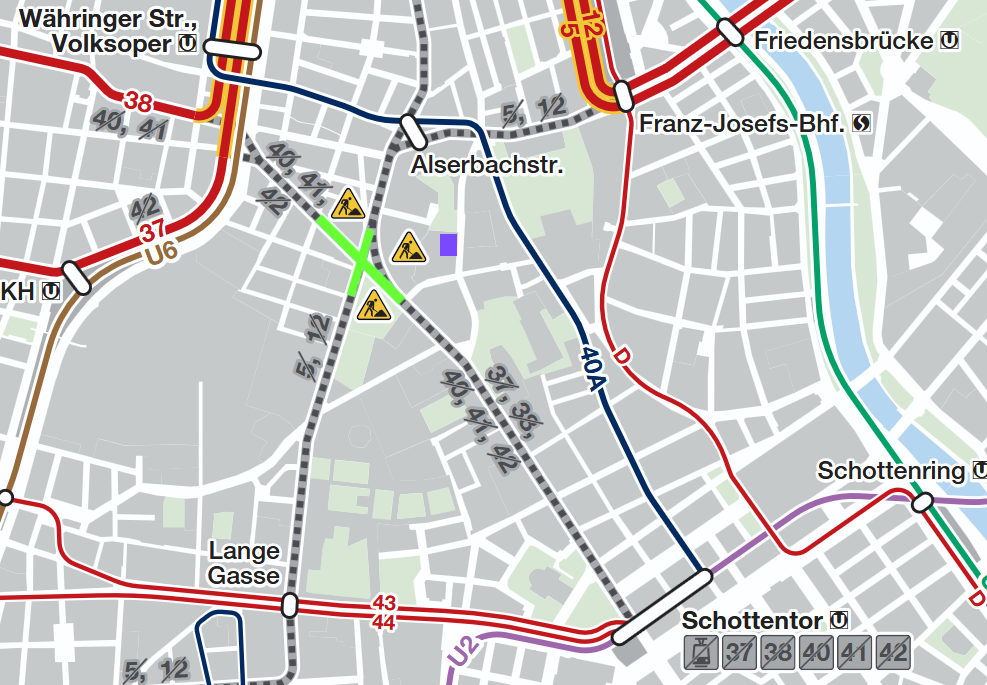
To reach the ESI the best options are Tram line D to Bauernfeldplatz (on the image where the red "D" is located, 8 minutes walking), the U6 to Währinger Straße / Volksoper (12 minutes walk), or the U2 to Schottentor (17 minutes walk). Car access to ESI is impacted, but generally possible (see extent of the green markings on the image, some streets are one way only).
Larger image with more details
Programme Synopsis
The strong interaction and its quantum field theory (QFT) description by virtue of Quantum Chromodynamics (QCD), an SU(3) gauge theory, are at the center point of all scattering reactions at particle colliders such as the Large-Hadron-Collider (LHC). Making reliable and accurate predictions for experimentally accessible S-matrix elements and cross sections is the foundation of acquiring access to the more subtle electroweak effects ($Z$, $W^\pm$, photons, Higgs particle) and to potential effects of physics beyond the Standard Model. Essential QCD properties that permeate all its applications are the asymptotic freedom and the fact that the gluons, the QCD gauge bosons, are massless. Asymptotic freedom dictates by the QCD renormalization group flow that the QCD gauge coupling $\alpha_s$ is small at very high energies, where perturbative methods can be employed, but large and non-perturbative at low energies, such that quarks and gluons are only observable in form of hadron bound states such as the protons and neutrons or the pions.
That the gluons are massless implies that if a gluon energy is very small or if it is collinear to another particle, it can become unresolved. This means that it is effectively invisible, yielding a strong connection with S-matrix elements without that gluon. This connection is associated with cancelling infrared divergent contributions in both types of matrix elements which become more intricate when the order in perturbation theory or the number of external gluons increases. Depending on the observable considered, these singular structures also imply the occurrence of large logarithmic corrections and are relevant in establishing proofs of factorization, where complicated scattering processes can be separated into universal (distribution) functions defined quantum field theoretically and themselves obeying a renormalization group flow. Well known and established examples are the parton distribution functions, describing the longitudinal momentum distribution of quarks and gluons in hadrons like the proton, or fragmentation functions, describing the momentum distribution of hadrons emerging from an inclusive hard interaction. This factorization and the field theoretic concepts on which factorization is based on are, in one way or another, the foundation of all theoretical predictions and simulations for collider processes where the strong interactions play any role.
Within the particle physics community, on the one side, there is continuous progress in improving the theoretical description within well-established factorization approaches, e.g. by adding higher order $\alpha_s$ corrections. On the other side, there is an endeavor to extend our systematic knowledge on factorization structures to somewhat less established processes and non-perturbative effects, where the understanding is more limited or subject to less rigorous modelling approaches, or to extend factorization beyond the leading power. The ESI thematic programme “New Paradigms for Harnessing Quantum Field Theory at Colliders” is intended to provide a development, communication and collaboration space for a number of such less established types of aspects, which are becoming increasingly attractive concerning novel theoretical insights and at the same time are becoming more important in experimental analyses. The focus topics of the thematic program, which are well interconnected, are outlined below. Progress on many of these theoretical directions will also have a direct impact on the ongoing experimental collider program and the analysis of the acquired data at the LHC.
The purpose of the workshop is to bring together internationally recognized experts and young researchers at the interface of QFT and collider physics phenomenology. We like to support exchange and collaboration of groups, working on connected directions but using different approaches, to foster new developments and insights into many interesting questions and to contribute towards new developments.
Topics and Structure of the Workshop
The workshop lasts for 5 weeks and each week roughly focuses on one of five focus topics. The tentative schedule is as follows.
July 27 - July 31: Week1 - QCD at Next-to-Leading Power: Factorization and Novel Singularities
The week focuses on the physics of effects that are formally suppressed from the perspective of established leading power factorization theorems.
August 3 - 7: Week 2 - Energy-Energy Correlators for Collider QCD
The week focuses on angular sensitive collider observables and inclusive fixed-particle correlation function weighted by the particle energy.
August 10 - 14: Week 3 - Color Evolution from Non-Global Logarithms to Small-x
The week focuses on improving the understanding of observables where certain parts of phase space are excluded.
August 17 - 21: Week 4 - Improving Perturbative Precision and the Treatment of Nonperturbative effects in Cross Sections and Simulations
The week focuses on new developments adding higher perturbative orders and precision in cross section predictions and simulations and the systematic understanding of nonperturbative effects in collider processes.
August 24 - 28: Week 5- Transverse Momentum Distributions, from the LHC to the EIC
The week focuses on observables and factorization functions sensitive to momentum components perpendicular to the beam directions.
Code of conduct
We ask all participants to respect our code of conduct.
Topics and Structure of the Workshop
The workshop lasts for 5 weeks and each week roughly focuses on one of five focus topics. The tentative schedule is as follows.
Scheduled presentations and talks
Each Tuesday and Thursday morning there will be presentations 10:00 - 11:00 and 11:30 - 12:30 by invited speakers with a coffee break from 11:00 - 11:30. Blackboard presentations and room for discussion are encouraged. On Wednesday morning there is the possibility to have max 2 additional talks on the request of participants in coordination with the organizers.
Sharing information
Speakers as well as all other participants of the programme are invited to provide supplementary information intended for all participants using the chat and sharing tool Slack. A link to the Slack ESI programme page will be provided before the programme starts.
ESI acknowledgement for publications
The way how you can show your appreciation to the ESI and how the ESI itself shows its impact to the University to acquire its ongoing funding is that you acknowledge the ESI in the publications that emerge during your ESI stay or that were supported by your stay at the ESI in any way. The ESI gathers this information for its yearly report to the University Rectorate, which is important for its continuing funding. We strongly encourage you to add such an acknowledgement to your papers and to let the organizers know about it, such that information can be passed to the ESI staff.
We thank the Erwin-Schrödinger International Institute for Mathematics and Physics at the University of Vienna for partial support during the Programme "New Paradigms for Harnessing Quantum Field Theory at Colliders", July 27 - August 28, 2026.
ESI access outside office hours
The ESI's office hours are between 9:00 and 17:00 each working day, Monday till Friday. The ESI is closed during the weekend (Saturday and Sunday). Outside office hours, during the weekend and on holidays you need the magnetic ESI access card to enter the ESI site. You can get an ESI access card from the ESI staff during office hours paying a deposit of 40 Euros, which is returned to you once you give the card back to the ESI staff.
Things to do in Vienna
There are lots of interesting things for you or your family to do in Vienna in summer. Events, water, mountains, sightseeing, museums, outdoor, indoor, you name it. You can find all information on the internet. Some useful links are collected below.
Events and opportunities of all kinds
Tensions in TMD factorization: The fate of sub-leading soft contributions
Power correction from detectorology
Resummation of double logarithms from soft-fermion exchange
Multi-collinear limits of scattering amplitudes
Energy Correlators as a New Probe of Hadron Structure
Generalized Detector Correlators
Collinear Factorization Violation and Reggeization
The theory of jet quenching
Higher-point Energy Correlators: Factorization in the Back-to-Back Limit & Non-perturbative effects
Imaging Boosted Boson Jets with Energy Correlators
QCD Factorization at Hadron Colliders
New Perspectives on Precision Nucleon Tomography
Factorization and IR sensitivity in full colour
Coherence-violating logarithms for general N-jettiness and the color algebra of sector generators
Diffraction from first principles
Jets as Light-Ray Measurements: the Strong-Coupling Limit
Local subtraction of IR divergences at higher orders in perturbative QCD
Local Unitarity and momentum-space numerical integration for perturbative QFT
Asymptotic states in weak interactions
TMD Evolution in Nuclear Matter
The Regge Limit of Gravity
Introduction to Theory Nuisance Parameters
Application of TNPs in fitting resummed predictions to data at high precision
Threshold Dynamics of Top-Antitop Production at the LHC
Quarkonium production in the TMD framework
Towards a Quantum Information Theory of Hadronization
Chiral Perturbation Theory for Non-local Matrix Elements at Subleading Power
Organizers
| Name | Affiliation |
|---|---|
| Alessandro Broggio | University of Vienna |
| André H. Hoang | University of Vienna |
| Bianka Meçaj | Los Alamos National Laboratory |
| Simon Plätzer | University of Graz |
| Massimiliano Procura | University of Vienna |
| Rudi Rahn | University of Vienna |
| Malin Sjödahl | Lund University |
| Iain W. Stewart | MIT |
Attendees
| Name | Affiliation |
|---|---|
| Prem Agarwal | Karlsruhe Institute of Technology |
| Simone Alioli | University Milano-Bicocca |
| Philipp Aretz | MIT |
| Roger Balsach | DESY Hamburg |
| Andrea Banfi | University of Sussex |
| Damiano Barcaro | DESY Hamburg |
| Thomas Becher | University of Bern |
| Guido Bell | University of Siegen |
| Arindam Bhattacharya | DESY Hamburg |
| Philipp Böer | CERN, Geneva |
| Ankita Budhraja | University of Amsterdam |
| Bernd Carmann | Universität Wien |
| Hao Chen | MIT |
| Marston Copeland | Los Alamos National Laboratory |
| Tyler Corbett | University of Vienna |
| Mrinal Dasgupta | University of Manchester |
| Federica Devoto | Stanford University |
| Gerhard Ecker | University of Vienna |
| Anna Ferdinand | MIT |
| Silvia Ferrario Ravasio | University of Torino |
| Andrea Ferroglia | New York City College of Technology |
| Anjie Gao | SLAC National Accelerator Laboratory |
| Einan Gardi | University of Edinburgh |
| Maria Vittoria Garzelli | University of Hamburg |
| Jonathan Gaunt | University of Manchester |
| Alessandro Gavardi | University of Torino |
| Jürg Haag | University of Bern |
| Valentin Hirschi | University of Bern |
| Jack Holguin | University of Manchester |
| Michael Hollnbuchner | University of Vienna |
| Dennis Horstmann | Karlsruhe Institute of Technology |
| Max Jaarsma | Johannes-Gutenberg Universität Mainz |
| Sebastian Jaskiewicz | University of Bern |
| Elizabeth Jenkins | University of California, San Diego |
| Jack Jenkins | University of Siegen |
| Brian Jiang | MIT |
| Lizhi Oliver Jin | University of Vienna |
| Daekyoung Kang | Fudan University |
| Zhongbo Kang | University of California, Los Angeles |
| Kyle Lee | Argonne National Laboratory |
| Stefan Leupold | Uppsala University |
| Yibei Li | Johannes-Gutenberg Universität Mainz |
| Giovanni Limatola | DESY Hamburg |
| Xiaohui Liu | Beijing Normal University |
| Michael Luke | University of Toronto |
| Axel Maas | University of Graz |
| Aneesh Manohar | University of California, San Diego |
| Giulia Marinelli | DESY Hamburg |
| Vicent Mateu Barredo | Universidad de Salamanca |
| Kirill Melnikov | Karlsruhe Institute of Technology |
| Jose Manuel Mena Valle | Universidad de Salamanca |
| Sven-Olaf Moch | University of Hamburg |
| Pier Monni | CERN, Geneva |
| Matthias Neubert | Johannes-Gutenberg Universität Mainz |
| Nicole Oberth | DESY Hamburg |
| Aditya Pathak | DESY Hamburg |
| Emanuele Re | University Milano-Bicocca |
| Anton Rebhan | Vienna University of Technology |
| Ira Rothstein | Carnegie Mellon University |
| HongYi Ruan | Peking University |
| Giuseppe Scala | University of Milano-Bicocca |
| Stella Schindler | Los Alamos National Laboratory |
| Dominik Schwienbacher | University of Bern |
| Ignazio Scimemi | Universidad Complutense de Madrid |
| Ding-Yu Shao | Fudan University |
| Maximilian Stahlhofen | Albert Ludwigs U Freiburg |
| Aneca Su | MIT |
| Zhiquan Sun | University of California, Berkeley |
| Robert Szafron | Brookhaven National Laboratory |
| Frank Tackmann | DESY Hamburg |
| John Terry | Argonne National Laboratory |
| Varun Vaidya | University of South Dakota |
| Leonardo Vernazza | Istituto Nazionale di Fisica Nucleare, sezione di Torino |
| Gherardo Vita | CERN, Geneva |
| Rebecca von Kuk | University of Bern |
| Wouter Waalewijn | University of Amsterdam |
| Zhen Xu | DESY Hamburg |
| HuaXing Zhu | Peking University |
- Type:
- Thematic Programme
- When:
- July 27, 2026 — Aug. 28, 2026
- Where:
- ESI Schrödinger Lecture Hall
- Organizer(s):
-
Alessandro Broggio (U of Vienna)
André H. Hoang (U of Vienna)
Bianka Meçaj (LANL, Los Alamos)
Simon Plätzer (U of Graz)
Massimiliano Procura (U of Vienna)
Rudi Rahn (U of Vienna)
Malin Sjödahl (Lund U)
Iain W. Stewart (MIT, Cambridge)