The ESI Medal 2026 is awarded to Ingrid Daubechies
Published on June 1, 2026
Update (14.09.26): ceremony postponed.
The Medal of the Erwin Schrödinger Institute for Mathematics and Physics for the year 2026 is awarded to Ingrid Daubechies, the James B. Duke Distinguished Professor Emeritus of Mathematics at Duke University.
Ingrid Daubechies is honored the ESI Medal 2026 for her fundamental and transformative contributions to mathematical information science. In addition to her groundbreaking work in the wavelet theory, she is honored for a novel way of detecting sparsity in data using the iterative least squares algorithm, for her seminal advances in the problem of phase retrieval, her proof of superiority of deep neural networks over standard approximation methods, and for creating image processing tools helping in art restoration projects.
The award ceremony will take place on October 30, 2026, in 2027 at a date that will be announced well in advance.
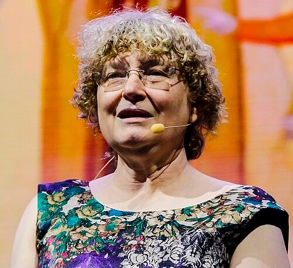 Ingrid Daubechies was born in 1954 in Houthalen, Belgium. She obtained her Ph.D. in theoretical physics in 1980. Beginning in 1981, she spent two postdoctoral years in the Physics Department at Princeton University, after which she returned to Belgium to continue her research career at the Vrije Universiteit Brussel. She visited the Courant Institute at New York University in 1986, where she made her first major scientific breakthrough, constructing compactly supported continuous wavelets that require only a finite amount of processing. This enabled wavelet theory to enter the realm of digital signal processing. In 1987, Daubechies joined the Murray Hill AT&T Bell Laboratories' New Jersey facility. From 1994 to 2010, Daubechies was a professor at Princeton University -- the first female full professor of mathematics. In 2011 Daubechies moved to the department of mathematics and electrical and computer engineering at Duke University. Her sprawling research career has touched fields as diverse as art restoration, evolutionary biology, electrical engineering and, most notably, image and data processing. Her most famous contributions concern wavelets, mathematical structures essential for modern signal processing. She has received several awards, including the Louis Empain Prize for Physics in 1984, the American Mathematical Society Steele Prize for Exposition (1994) and Seminal Research (2011), the AMS Ruth Lyttle Satter prize (1997), the Eduard Rhein Foundation Basic Research Award (2000), the James Kilby Medal of the IEEE Signal Processing Society (2011), the Okawa Prize (2011), the Nemmers prize (2012). She was elected to the United States National Academy of Sciences in 1998 and to the United States National Academy of Engineering in 2015. She gave a plenary lecture at the International Congress of Mathematicians (1994) and was the first woman president of the International Mathematical Union (2011–2014). In 2012, Albert II of Belgium granted Daubechies the title of Baroness. In 2019 Daubechies was elected to the German Academy of Sciences Leopoldina and in 2023 she was awarded the Wolf Prize for her work in the creation and development of wavelet theory and modern time-frequency analysis.
The ESI Medal
The Medal of the Erwin Schrödinger International Institute for Mathematics and Physics, or ESI Medal, awarded in 2020 for the first time, has been created to recognize outstanding achievements in any area of mathematics or physics, including contributions at the interface of the two fields. The previous recipients of the ESI Medal are Anton Alekseev (2020), Elliott Lieb (2021), Martin Hairer (2022), Isabelle Gallagher (2023), Piotr T. Chruściel (2024), and Michele Parrinello (2025).